
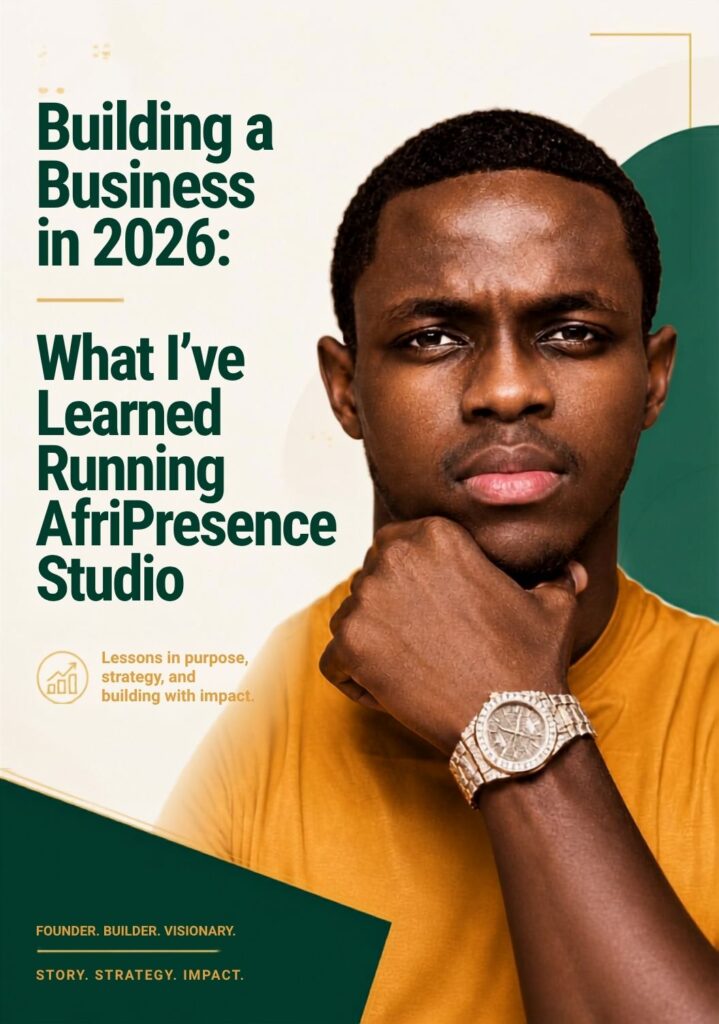
When I started AfriPresence Studio, I had a laptop, a decent grip on WordPress, and a lot of confidence that turned out to be equal parts useful and misplaced. A few years and a registered business name later, I’ve learned more from the mistakes than from the wins. This is the honest version of that journey.
The gap between “I can build websites” and “I run a business”
Knowing Elementor, Divi, and Gutenberg inside out made me a good website designer. It did not make me a business owner. Those are two different skill sets, and confusing them cost me time early on.
Building a business meant learning things nobody teaches you in a web design tutorial: how to price a service so it’s fair to the client and sustainable for you, how to write a proposal that gets read instead of ignored, how to manage a team when you’re used to working alone, and how to keep showing up on the admin side of things (registration, structured company profiles, compliance) even when it feels far removed from the creative work you actually love.
Getting AfriPresence properly registered with the CAC was one of those unglamorous but necessary steps. It doesn’t make for exciting content, but it’s the kind of foundation that lets you pitch to bigger clients and government-adjacent programmes with a straight face.
Clients teach you faster than courses do
Every client I’ve worked with, from hotels to real estate to clinics, has taught me something a course never could. Working with hospitality clients taught me that a beautiful website means nothing if it doesn’t convert bookings. Working with real estate clients taught me how much trust matters in a market where people are wary of being scammed online. Every industry has its own version of “what actually matters to the customer,” and you only learn that by being in the trenches with real businesses, not by reading a blog post about it (yes, the irony isn’t lost on me).
The biggest shift in my thinking came from realizing that most local businesses in Nigeria don’t need a website because it looks nice. They need it because it’s often the first and only impression a potential customer gets before deciding whether to trust them with their money. That reframes everything about how you design, write, and pitch.
Team management is a skill, not a side effect of hiring
I’ve had to make hard calls, including letting go of a graphics designer who submitted AI-generated work as his own. That wasn’t just a performance issue, it was a trust issue, and trust is the one thing you can’t compromise on if you want a team people (and clients) can rely on.
What I’ve learned is that building a team isn’t just about finding people who are good at the technical work. It’s about finding people who care about the outcome as much as you do, and being clear and fair with expectations so there’s no ambiguity later. I’m still learning this one. I don’t think anyone ever fully finishes learning it.
Systems save you, eventually
I used to do everything manually: outreach, follow ups, content scheduling, all of it. At some point that stops being hustle and starts being a bottleneck. Setting up an automated outreach workflow through n8n, connected to Gmail and Google Sheets, was one of the best decisions I made this year, even though getting it working the way I wanted took longer than I expected and came with its fair share of node configuration headaches.
The lesson wasn’t “automation is magic.” It was that systems only pay off once you’ve done the manual version enough times to know exactly what you’re automating and why. Automating a broken process just gets you a faster broken process.
Setbacks are part of the build, not a detour from it
There was a stretch where afripresence.com got compromised through a malware attack, core WordPress directories renamed, a backdoor planted, the whole unpleasant experience. It was stressful in the moment, but recovering it taught me more about WordPress security, file structures, and backups than years of building sites ever did. I don’t wish that experience on anyone, but I also don’t regret what it taught me.
That’s been a pattern. The moments that felt like setbacks, whether it was a project falling through, a client saying no, or a technical fire I had to put out at midnight, ended up being the moments that actually built the skill and the resilience the business needed.
What I’d tell someone starting out
Build the boring parts of the business as seriously as the creative parts. Registration, systems, team clarity, and financial discipline are not distractions from the real work. They are the real work, just the part that doesn’t show up in a portfolio.
Let your clients teach you. Every project is a masterclass if you pay attention to what the client actually needs versus what they say they need.
And don’t wait until you feel ready to take the next step, whether that’s hiring, automating, or pitching a bigger client than you think you deserve. I wasn’t ready for most of what AfriPresence has taken on. I got ready by doing it.
This is still very much a work in progress. But if there’s one thing running this business has taught me, it’s that the progress is the point.